Posted: 28 October 2010 1320 hrs
ISLAMABAD: A moderate earthquake of 5.7 magnitude jolted northwest Pakistan near the border with Afghanistan on Thursday but there were no immediate reports of casualties, an official said.
Tremors were felt in several cities in the northwest province of Khyber Pakhtunkhwa and its capital Peshawar as well as in Pakistan-administered Kashmir, meteorological department chief Arif Mehmood told AFP.
The quake struck at 08:59 am (0359 GMT) with a magnitude of 5.7 and its epicentre was located 280 kilometres (175) northwest of Peshawar near the Afghanistan-Tajikistan border, he said.
"No loss of life or damage to property has been immediately reported," he said.
Pakistan was hit by a 7.6-magnitude earthquake in October 2005 that killed more than 73,000 people, mainly in Pakistan-controlled Kashmir and parts of Khyber Pakhtunkhwa.
-AFP/wk
Thursday, October 28, 2010

Tuesday, October 26, 2010
23 dead, scores missing after Indonesia quake
Posted: 26 October 2010 1635 hrs
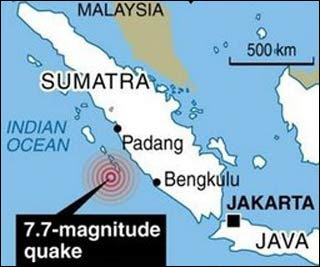
JAKARTA - At least 23 people are dead and scores missing, including nine Australians, after a powerful earthquake hit Indonesia's west coast and triggered a tsunami, officials said Tuesday.
The 7.7-magnitude earthquake, which struck in the Mentawai Islands area west of Sumatra late Monday, caused waves as high as three metres (10 feet) that damaged residential areas in several islands.
A tsunami warning was issued after the quake and a group of Australian visitors reported that their boat was destroyed by a "wall of white water" crashing into a bay.
Rick Hallet, an Australian who operates a boat-chartering business in Sumatra, said he had 15 people on board his vessel in a bay off the islands when the quake struck.
"We felt a bit of a shake underneath the boat... then within several minutes we heard an almighty roar... I immediately thought of a tsunami and looked out to sea and that's when we saw the wall of white water coming at us," he said.
Arlyno, an official from the Disaster Management Agency, told AFP that 23 people were killed in the Mentawai islands and that 167 people had gone missing.
While remote, the Mentawai Islands are popular with tourists, especially surfers.
Health Ministry Crisis Centre head Mudjiharto, who goes by one name, said the waves reached three metres high and waters swept as far as 600 metres inland on South Pagai island, one of the Mentawai chain.
"Eighty percent of buildings in Muntei village have been damaged by the waves and many people are missing there," Mudjiharto said.
He said medical personnel were on their way to the hardest-hit areas.
Rescuers launched a hunt for a boat believed to be carrying a group of nine Australians which has been missing since the quake.
"We are sending a boat and a chartered plane to search for the boat," said Andrew Judge of SurfAid International.
It was reportedly not equipped with a satellite telephone but SurfAid's Dave Jenkins said its Australian captain Chris Scurrah had "been around here for a long time. He knew to contact in if he could. So that's why we're extra concerned."
The undersea quake hit at 9:42pm (1442 GMT) at a depth of 20.6 kilometres (12.8 miles), 240 kilometres west of Bengkulu on Sumatra island and 280 kilometres south of Padang, the US Geological Survey said.
"A significant tsunami was generated by this earthquake," said the Pacific Tsunami Warning Center. The warning was later withdrawn after the danger of further waves had passed.
The first tremor was followed by strong magnitude 6.1 and 6.2 aftershocks several hours later.
Hallet recounted his group's ordeal when the quake struck, with some climbing trees to survive.
"The bay we were in was several hundred metres across and the wall of white water was from one side to the other, it was quite scary," he told Fairfax Radio Network.
Another boat was anchored next to them, he said.
"The wave picked that boat up and brought it towards us and ran straight into us and our boat exploded, caught on fire, we had a fireball on the back deck and right through the saloon within seconds.
"I ordered everyone up to the top deck to get as high as possible, then the boat exploded and we had to abandon ship," he told Australia's Nine Network.
The group jumped into the water, some of them being swept 200 metres inland, and took shelter by climbing trees, waiting for 20 minutes to half an hour until the surges passed.
Eventually all the group, nine of whom were Australian, were accounted for, he said.
Residents reported shaking as far away as the West Sumatran provincial capital of Padang when the main quake struck.
Indonesia sits on the Pacific "Ring of Fire," where the meeting of continental plates causes high volcanic and seismic activity, and the archipelago is frequently struck by powerful earthquakes.
A 7.1-magnitude quake off the north coast of Papua in June killed 17 people and left thousands homeless.
The 2004 Asian tsunami -- triggered by a 9.3-magnitude quake off Sumatra --
killed at least 168,000 people in Indonesia alone.
A 7.6-magnitude quake killed about 1,000 people in the port of Padang on September 30 last year.
- AFP/ir
Major 7.7 quake strikes Indonesia
Posted: 26 October 2010 1341 hrs
JAKARTA: A major 7.7-magnitude earthquake struck off the west coast of Indonesia on Monday, seismologists said, causing localised waves in the remote area.
A tsunami warning was issued, and while it was later withdrawn and no casualties were confirmed, a group of Australian visitors reported that their boat was destroyed by a "wall of white water" crashing into a bay.
The undersea quake hit Indonesia's Kepulauan Mentawai region at 9:42 pm (1442 GMT) at a shallow depth of 20.6 kilometres (12.8 miles), the US Geological Survey said.
The Mentawai Islands, 240 kilometres west of Bengkulu on Sumatra island and 280 kilometres south of Padang, are popular with tourists.
Rick Hallet, an Australian who operates a boat-chartering business in Sumatra, had 15 people on board his vessel in a bay off the islands when the quake struck.
"We felt a bit of a shake underneath the boat... then within several minutes we heard an almighty roar... I immediately thought of a tsunami and looked out to sea and that's when we saw the wall of white water coming at us," he said.
"The bay we were in was several hundred metres across and the wall of white water was from one side to the other, it was quite scary," he told Fairfax Radio Network.
Another boat was anchored next to them, he said. "The wave picked that boat up and brought it towards us and ran straight into us and our boat exploded, caught on fire, we had a fireball on the back deck and right through the saloon within seconds.
"I ordered everyone up to the top deck to get as high as possible, then the boat exploded and we had to abandon ship," he told Australia's Nine Network.
The group jumped into the water, some of them being swept 200 metres inland, and took shelter by climbing trees, waiting for 20 minutes to half an hour until the surges passed.
Eventually the group, nine of whom were Australian, was accounted for, he said.
The 7.7 earthquake was followed by powerful magnitude 6.1 and 6.2 aftershocks about five and eight hours later in the same area.
Residents reported shaking as far away as the West Sumatran provincial capital of Padang relating to the earlier quake, but fears of widespread damage eased a few hours later.
"There was shaking that went on for about three seconds or so. Residents panicked and ran to the hills but now they are starting to come down. There's no report of casualties or damage," Disaster Management Agency spokesman Priyadi Kardono told AFP.
The Indonesian Geophysics and Meteorology agency lifted an earlier tsunami warning.
The power and shallow depth of the earthquake prompted the US-based Pacific Tsunami Warning Center to issue a "tsunami watch" bulletin to guide local authorities on how to respond but that was later cancelled.
Indonesia sits on the Pacific "Ring of Fire," where the meeting of continental plates causes high volcanic and seismic activity, and the archipelago is frequently struck by powerful earthquakes.
A 7.1-magnitude quake off the north coast of Papua in June killed 17 people and left thousands homeless.
The 2004 Asian tsunami -- triggered by a 9.3-magnitude quake off Sumatra -- killed at least 168,000 people in Indonesia alone.
A 7.6-magnitude quake killed about 1,000 people in the port of Padang on September 30 last year.
-AFP/wk
Sunday, October 3, 2010
Earthquake hits central Japan
Posted: 03 October 2010 0851 hrs
TOKYO: A 4.7-magnitude quake hit areas some 200 kilometres (125 miles) north of Tokyo Sunday, but no tsunami warning was issued, Japan's meteorological agency said.
The quake hit Jetsu City and surrounding areas at 9:26am (0026 GMT) at a depth of 20 kilometres, the agency said.
Around 20 per cent of the world's most powerful earthquakes strike Japan, which has developed one of the most sophisticated tsunami warning systems.
Just a moment before the quake struck, warnings for a strong tremor were flashed across television screens.
There were no immediate reports of damage.
-AFP/wk
Friday, October 1, 2010
Moderate quake jolts Taiwan
Posted: 01 October 2010 0939 hrs
TAIPEI: A 5.1-magnitude earthquake struck off northern Taiwan Friday, the island's Seismology Centre said, but there were no immediate reports of damage and no tsunami warning was issued.
The quake hit at 3:56 am (2156 GMT Thursday) 11 kilometres (seven miles) north of the city of Ilan at a depth of 102 kilometres.
Taiwan lies near the junction of two tectonic plates and is regularly hit by earthquakes.
In September 1999, a 7.6-magnitude quake killed around 2,400 people in the deadliest natural disaster in the island's history.
-AFP/wk
Thursday, September 9, 2010
6.1-magnitude quake strikes near Chile coast
Posted: 09 September 2010 1637 hrs
WASHINGTON : A strong 6.1-magnitude earthquake struck just off the coast of central Chile early Thursday, the US Geological Survey reported.
The Pacific Tsunami Warning Center has not issued an advisory on the quake, which hit at 3:28 am (0728 GMT) about 35 kilometres (20 miles) southwest of the coastal city of Concepcion, at a depth of 17 kilometres (10 miles).
The quake struck close to the epicentre of a massive 8.8-magnitude earthquake that rocked Chile on February 27, sparking a huge tsunami that killed 521 people and swept away entire villages. - AFP/ms
Saturday, September 4, 2010
Widespread devastation after 7.0 quake
AFP - 1 hour 55 minutes ago
CHRISTCHURCH (AFP) - – A powerful 7.0 magnitude earthquake caused widespread devastation in New Zealand's second largest city of Christchurch Saturday, with officials saying it was "extremely lucky" no one was killed.
Initial estimates put the damage at up to two billion dollars (1.44 billion US) as buildings collapsed, gas, water and sewage lines were ruptured, some bridges became impassable and electricity supplies were cut.
Frightened residents fled from their homes to find streets covered in rubble and glass, but despite the extent of the damage only two people were seriously injured in the city of 340,000 people.
The quake struck just before dawn when few people were on the streets as building facades crashed to the ground, crushing parked cars and showering the roads with shattered glass.
A state of emergency was declared in Christchurch and a 7:00 pm to 7:00 am curfew imposed in the city centre as residents were warned to stay away from damaged buildings for fear of further collapses as severe aftershocks continued to rock the city.
"I think we've been extremely lucky as a nation that there's been no fatalities... we're blessed actually," Civil Defence Minister John Carter said after being briefed on the impact of the quake.
He described it as a "significant disaster" and urged people "don't panic" as strong aftershocks continued throughout the day. Facts:Quake among New Zealand's worst
Christchurch mayor Bob Parker said he was "horrified by the amount of damage" which daylight showed was considerably worse than first thought.
"We've decided to declare the state of emergency in the city. It just makes it a bit easier for us now to move people out of buildings if necessary, close streets down," Parker announced on national radio.
"There would not be a house, there would not be a family in our city that has not in some way have damage done to their person, to their property.
"I think it's like an iceberg; there is ... below the visible line, significant structural damage."
The quake, initially recorded at a magnitude of 7.4, struck at 4:35 am (1635 GMT Friday) at a depth of five kilometres (three miles) some 45 kilometres west of Christchurch, the US Geological Survey said.
"Oh my God. There is a row of shops completely demolished right in front of me," resident Colleen Simpson told the Stuff website, adding that many people had run out onto the streets in fear.
Christchurch Hospital spokeswoman Michele Hider said two men in their 50s were seriously injured -- one was hit by a falling chimney and the other was cut by falling glass.
Police closed the centre of the city as looters targeted damaged shops, police Inspector Mike Coleman said.
"There's considerable damage there, and we've already had reports of looting. Shop windows are broken and obviously it's easy pickings for displays and things."
In the hours immediately after the quake, roads in the seaside suburbs were packed with cars as residents moved inland, but there was no tsunami.
Kevin O'Hanlon, from the Mairehau area of Christchurch, said: "Just unbelievable. I was awake to go to work and then just heard this massive noise and, boom, it was like the house got hit. It just started shaking. I've never felt anything like it."
Mayor Parker said he was in bed when the quake struck and he was "absolutely scared. I've never felt anything like it and I've experienced, like most Kiwis, a number of good shakes." Related article:City 'wobbles like jelly' in powerful quake
The quake, felt throughout the South Island and the lower North Island, was the most destructive in New Zealand since the 1931 tremor in Hawke's Bay that killed 256 people.
It caused the temporary shutdown of Christchurch International Airport, forcing the diversion of inbound international flights to Auckland and Wellington until it reopened Saturday afternoon after being assessed for damage.
New Zealand sits on the so-called "Ring of Fire", the boundary of the Australian and Pacific tectonic plates, and experiences up to 15,000 tremors a year. It averages at least one a day that is magnitude 4.0 or stronger.
Subscribe to:
Posts (Atom)